Introduction
Rapid industrialization and manufacturing growth have driven economic development, but they also bring significant environmental challenges—particularly air pollution. Industrial chimneys, boilers, generators, and processing units release various gases and particulate matter into the atmosphere.
To regulate industrial pollution, environmental monitoring bodies like the Maharashtra Pollution Control Board (MPCB) and the Central Pollution Control Board (CPCB) have mandated strict guidelines. For factory owners and plant managers, conducting regular Stack Emission Testing and Ambient Air Quality Monitoring is essential not only to avoid legal action but also to build a sustainable, eco-friendly business model.
1. Understanding Stack Emission Testing vs. Ambient Air Monitoring
It is important to understand the distinct roles these two monitoring processes play in an industrial ecosystem:
-
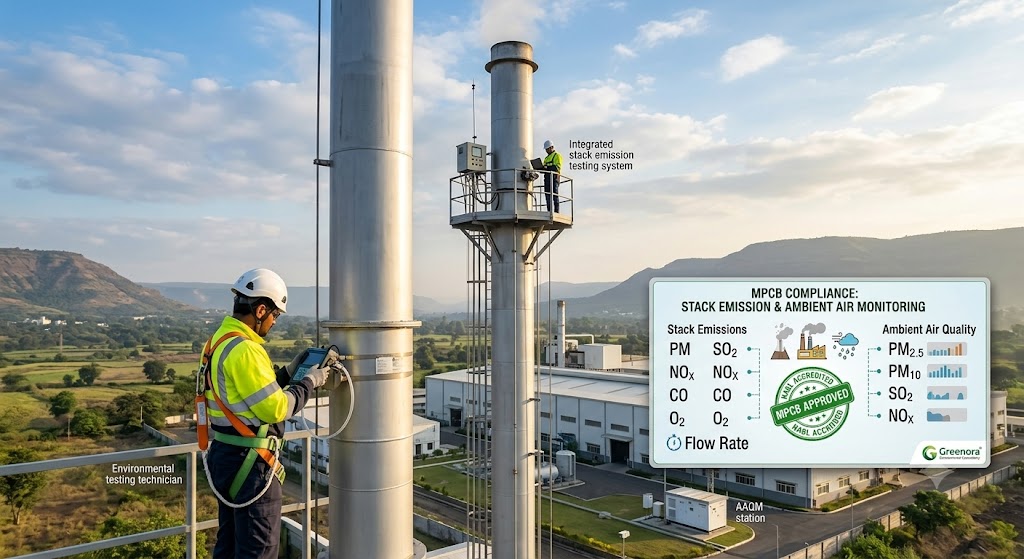
Stack Emission Testing: Focuses on measuring pollutants released directly at the source—such as factory chimneys, stacks, boilers, furnaces, and DG sets. Parameters checked include Particulate Matter (PM), Sulfur Dioxide ($\text{SO}_2$), Nitrogen Oxides ($\text{NO}_x$), Carbon Monoxide ($\text{CO}$), and toxic gases.
-
Ambient Air Quality Monitoring (AAQM): Measures the quality of outdoor air surrounding the factory premises. It determines how industrial emissions impact the local air quality and ensures that parameters like $\text{PM}_{2.5}$, $\text{PM}_{10}$, $\text{SO}_2$, and $\text{NO}_x$ remain within ambient standards.
2. Why Air & Stack Monitoring is Essential for Factories
A. Regulatory & Statutory Compliance (MPCB Norms)
Under the Air (Prevention and Control of Pollution) Act, 1981, all industrial units generating air emissions must obtain a Consent to Establish (CTE) and Consent to Operate (CTO) from the MPCB. Regular monitoring reports from an accredited laboratory are compulsory to:
-
Renew CTO permissions without hassle.
-
Submit required statutory documentation and annual environmental statements.
-
Demonstrate adherence to prescribed emission limits.
B. Avoid Heavy Fines & Closure Notices
Non-compliance or exceeding permissible emission thresholds can lead to severe repercussions from regulatory authorities, including:
-
Issue of Show Cause Notices or Stop Work orders.
-
Heavy financial penalties and forfeiture of bank guarantees.
-
Disconnection of electricity or water supply to the plant.
C. Early Detection of Machinery Inefficiencies
Excessive smoke or high gas concentrations from a stack often indicate incomplete fuel combustion, boiler fouling, or faulty pollution control equipment (such as bag filters, scrubbers, or electrostatic precipitators). Regular stack testing acts as a diagnostic tool to optimize fuel consumption and lower operational costs.
D. Protecting Worker Health & Local Communities
Poor air quality inside and around industrial premises adversely affects employee health, leading to respiratory issues and reduced productivity. Monitoring ensures a safe working environment and maintains positive relations with adjacent communities.
3. Best Practices for Industrial Air Monitoring
-
Schedule Regular Monitoring: Conduct quarterly or bi-annual monitoring as specified in your MPCB CTO condition.
-
Maintain Air Pollution Control Equipment (APCE): Keep wet scrubbers, baghouse filters, and cyclones well-maintained before sampling.
-
Work with Accredited Laboratories: Ensure testing and sampling are conducted by NABL-accredited or MPCB-approved environmental laboratories using calibrated instruments.
Partner with Greenora for Reliable Testing Services
At Greenora Environmental Consultancy & Laboratory Services, we provide certified sampling, stack emission testing, and ambient air monitoring using advanced instrumentation and standardized testing protocols. Our experienced team ensures precise data accuracy, helping your factory stay 100% compliant with MPCB standards.